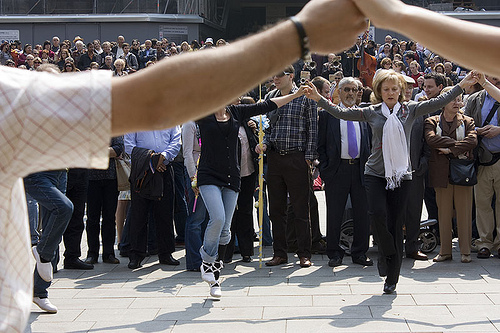
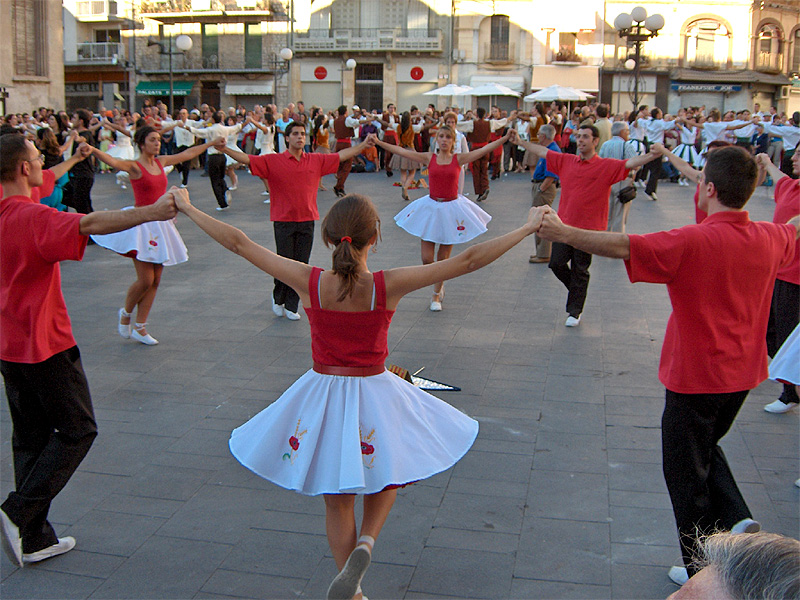
If you have ever stumbled upon a group of people dancing in circles in Barcelona, it is possible that you were observing the Sardana.
The Sardana is a style of dancing that is said to have originated around the sixteenth century, becoming a very popular dance in the areas of Garrotxa, Empordà and Roselló in the nineteenth-century, when the modern Sardana choreography was developed.
Initially, the Sardana dance was performed to the sound of only one instrument, but today the Sardana music is performed by a cobla, a band with 10 wind instruments, double bass and a small drum, played by a total of 11 musicians. Some of the instruments used are the tamborí, the tenora, the tible, the fiscorns, the trumpets, a double bass and a trombone.
The Sardana is a valued part of the Catalan culture, being one of the many activities that was banned by Spanish dictator Franco in the 40s, due to his dislike of the Catalan, who he considered a threat.
Today, the Saradana is danced with pride, in very public places, so it can be appreciated by all.
To dance the Sardana, people give hands, joining in a circle. Holding each other’s hands, the dancers raise their arms, following the leader’s indications for movements and timing. The greatest challenge of Sardana dancing, is getting the steps right, since most of the choreography happens from the waist down.
It would be wise to observe the dance for a while or even practice it at home, before joining a Sardana circle. The dance steps are so precise, that if one person takes a wrong step, it can break the rhythm for the entire circle!
People of all ages and any sex can dance the Sardana, as long as they know how to do it. When a Sardana circle starts becoming too big, the circle breaks and smaller circles start being formed.
The Sardana is danced in almost any of the official Catalan celebrations, particularly Sant Joan, which takes place in June, and La Mercé celebrations, which happen in September.
Getting locked out or dealing with a broken key can happen to anyone — and…
Barcelona’s Mediterranean climate, with increasingly warmer and longer summers, makes air conditioning an essential feature…
Maybe you're thinking about selling a property or you've just inherited one or more real…
Do you enjoy strolling among trees and plants, away from the hustle and bustle of…
If you are planning to move to Barcelona for a few months or permanently, one…
ShBarcelona establishes itself as the leading agency within the Apialia Eixample Group, reaffirming its position…